


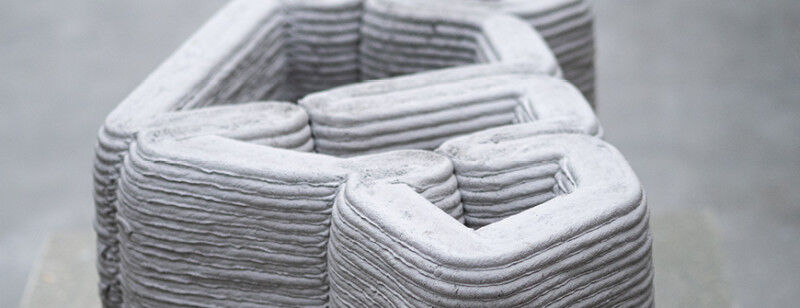
Instead of using more and more concrete and steel, a European research team including Empa is focusing on intelligent shapes, digital manufacturing, and alternative binders. The aim is to create a climate-friendly building material that is delicate yet stable - and can be custom-made using 3D printing, dismantled, and reused.
Using as little mass as possible, without complex steel reinforcement and without cement, researchers at Empa, ETH Zurich, and other European partners aim to fundamentally change the way concrete is used in construction. In the EU project CARBCOMN, concrete components are also designed so that they can be easily dismantled after use and reused elsewhere. "On the one hand, we are using digital manufacturing methods to build in a resource-efficient manner. On the other hand, we are replacing conventional cement with binders that have a lower carbon footprint," says Empa researcher Moslem Shahverdi. Instead of cement, for example, steel slag is used - a waste-product from the steel industry.
The low-carbon footprint concrete used in the CARBCOMN project consists exclusively of industrial waste. It is formed into individual components using 3D printing and later assembled into load-bearing structures. Instead of conventional steel reinforcement, the consortium relies on so-called compression dominant structures. "Concrete can withstand a lot of compression, but little tensile stress," explains Shahverdi. That is why the researchers are developing structures that are primarily subjected to compression - similar to historic stone bridges with their arches.
Digital manufacturing enables them to precisely plan such geometrically optimized shapes and significantly reduce the amount of material used. Since the concrete is printed layer by layer, the need for concrete formwork is eliminated. Cavities are deliberately left where no reinforcement is necessary. "We plan these openings directly in the digital model so that the robot automatically leaves them open during printing," explains Shahverdi.
Lighter elements not only reduce material consumption, but also seismic stress in proportion to the weight loss - a decisive advantage in earthquake-prone regions. "Even a ten percent reduction in weight makes a big difference," says Shahverdi.
However, the concept cannot do entirely without steel rebars. They are only used where they are really necessary. This is where Empa brings one of its specialties to the project: iron-based shape memory alloys (Fe-SMA). These pre-stretched metals contract when heated - instead of expanding - and thus subsequently place components under compression. "We have been working with these special alloys for around 20 years," says Shahverdi. The Empa spin-off re-fer is therefore also contributing its expertise in the field of shape memory alloys to the CARBCOMN consortium.
Conventional steel reinforcements have to be pre-stressed in a complex process; shape memory alloys, on the other hand, are simply inserted into the concrete after printing. This has several advantages: The printing process remains automated and undisturbed, and the Fe-SMA rebars can be placed precisely where they are actually needed. Moreover, they can be separated from the concrete again later - which is crucial for being able to dismantle the components at a later date. According to the Empa researcher, these work steps are also to be automated in the long term. "In the future, a second robot could insert the Fe-SMA rebars directly after printing."
After 3D printing, the concrete components are placed in a chamber where CO2 is injected. This leads to a chemical reaction with the steel slag-based concrete mixture. "This process hardens the concrete and binds CO2 at the same time," says Shahverdi. The aim is to further increase strength with an optimized concrete mixture. If this is not sufficient, a small amount of cement could be added. "For normal civil engineering applications, this would already be a good starting point," Shahverdi is convinced.
Parallel to the material, the teams are developing new digital tools: A common platform is to cover the entire process from design to production - including sustainability and life cycle analyses. Architectural firms such as Zaha Hadid Architects are working closely with the engineers and materials scientists involved in the project. While the architects design free-form structures, the Empa team investigates the technical feasibility, tests materials, and develops connection technologies that allow for later dismantling. "We combine unique expertise here - 3D printing, structural performance, and our specialty: iron-based shape memory alloys," summarizes Shahverdi. A prototype is to be created by 2028 - a 3D-printed building module that demonstrates the feasibility of the new approach.
The CARBCOMN project
In the EU project CARBCOMN (Carbon-negative compression dominant structures for decarbonized and de-constructable concrete buildings), researchers are working with European partners to develop a climate-friendly and recyclable concrete construction method. The innovative building material binds CO2, consists exclusively of recycled materials, and minimize the requirement of conventional steel reinforcement. Digital manufacturing and 3D printing are used to create filigree yet stable structures. The focus is less on spectacular shapes and more on robust components for residential construction that can be connected in an earthquake-proof manner and reused later. The four-year project, which started in 2024, is funded by Horizon Europe and brings together eleven leading research institutions and architectural firms from across Europe, including Ghent University, TU Darmstadt, the University of Patras, ETH Zurich, and Empa, as well as Zaha Hadid Architects, Mario Cucinella Architects and the companies Tesis, orbix, incremental 3D and re-fer. The total budget is around six million euros, with Empa and its spin-off receiving more than one million of this amount.