







news
Earth Sciences
Results 21 - 40 of 277.
Earth Sciences - Physics - 05.06.2025

A spectacular breakthrough in geoscience shows that our planet is in motion even at a depth of 3000 kilometres. by Peter Rüegg, Corporate Communications Earthquakes, volcanic eruptions, shifting tectonic plates - these are all signs that our planet is alive. But what is revealed deep inside the earth surprises laymen and scientists alike: Almost 3000 kilometres below the Earth's surface, solid rock is flowing that is neither liquid, like lava, nor brittle like solid rock.
Environment - Earth Sciences - 29.05.2025
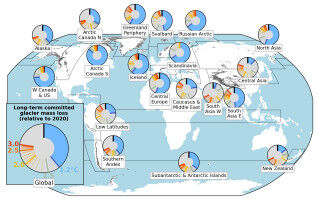
A new study with ETH Zurich, finds that if global warming exceeds the Paris Climate Agreement targets, the non-polar glacier mass will diminish significantly. However, if warming is limited to 1.5°C, at least 54 per cent could be preserved-more than twice as much ice as in a 2.7°C scenario.
Astronomy & Space - Earth Sciences - 14.05.2025

Several tectonic processes are occurring beneath the surface of Venus, according to a new study led by researchers from the University of Bern's Center for Space and Habitability (CSH) and NASA. They found that many of the numerous "coronae" scattered all'over Venus' globe are associated with gravity field perturbations, hinting at the sub-surface tectonic processes.
Environment - Earth Sciences - 12.05.2025

Hidden beneath the Antarctic ice lies a system of lakes and watercourses. An research team, including researchers, has for the first time directly observed the subglacial streams of West Antarctica. Their study shows how individual flood events influence the melting of the ice. In the autumn of 2021, an international team of researchers from New Zealand's Antarctic Science Platform set off towards the South Pole.
Earth Sciences - Physics - 19.03.2025

Colli Albani, an Italian volcano, has experienced major eruptions thousands of years ago that don't fit with current models. Using 3D imaging, a team from the University of Geneva has unraveled this phenomenon, paving the way for improved volcanic hazard mitigation. More than 800 million people live near an active volcano.
Environment - Earth Sciences - 27.02.2025

Extreme weather and climate events such as droughts and floods in Europe can be linked to shifts in the jet stream over the Atlantic.
Astronomy & Space - Earth Sciences - 25.02.2025

An international research team led by the University of Bern and Brown University in the US state of Rhode Island may have solved the mystery of the reddish color of Mars. The team identified the water-rich iron mineral ferrihydrite as the main culprit of the characteristic reddish Martian dust. This discovery could not only explain the planet's color, but also point to a wetter, potentially habitable Martian past.
Astronomy & Space - Earth Sciences - 25.02.2025

Researchers from the University of Bern, in collaboration with the University of Science and Technology Houari Boumediene in Algeria, have made significant progress in astrobiology. In a recently published study, they were able to detect fossil microorganisms in Messinian gypsum, which is found in Algeria, using the Bernese mass spectrometer LIMS.
Environment - Earth Sciences - 19.02.2025

The melting ice from glaciers worldwide is leading to an increased loss of regional freshwater resources. And it is causing global sea levels to rise at ever-greater rates. Since the year 2000, glaciers have been losing 273 billion tons of ice annually, according to estimates by an international research community led by researchers of the University of Zurich.
Environment - Earth Sciences - 19.02.2025

For Switzerland to achieve its net zero climate target, not only must it reduce its CO2 emissions, it must also find a way to store the greenhouse gas permanently. Researchers at ETH Zurich have investigated whether, and under what conditions, CO2 could be stored underground in Switzerland. To achieve its net zero climate target by 2050, Switzerland must press forward with the energy transition - whether in electricity, heating or mobility.
Environment - Earth Sciences - 19.02.2025

A recent study examines the effectiveness of environmental strains for the production of biocement. The study's lead author, Dimitrios Terzis, is an EPFL senior scientist and a co-founder of Medusoil, a company that produces organic binders and that opened a production plant in Vaud in 2024. "For me, it's essential to keep conducting fundamental research," says Terzis, a civil engineer at EPFL's Soil Mechanics Laboratory.
Earth Sciences - Environment - 06.02.2025

For the first time, an international team of researchers has shown that countless tiny ice quakes take place in one of Greenland's mightiest ice streams. This finding will allow the flowing of the ice stream and associated changes in sea level to be estimated more accurately. The great ice streams of the Antarctic and Greenland are like frozen rivers, carrying ice from the massive inland ice sheets to the sea - and a change in their dynamics will contribute significantly to sea-level rise.
Astronomy & Space - Earth Sciences - 03.02.2025

Meteoroid impacts create seismic waves that cause Mars to shake stronger and deeper than previously thought: This is shown by an investigation using artificial intelligence carried out by an international research team led by the University of Bern. Similarities were found between numerous meteoroid impacts on the surface of Mars and marsquakes recorded by NASA's Mars lander InSight.
Environment - Earth Sciences - 30.01.2025
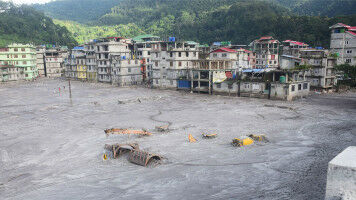
An international research team has concluded that the Sikkim flood disaster in the Himalayas in October 2023 was caused by some 14.7 million cubic meters of frozen moraine material collapsing into South Lhonak Lake, triggering a 20-meter flood wave. The event is a striking example of the increasing dangers of climate change in high mountain regions.
Earth Sciences - Environment - 15.01.2025

A study by the University of Bern and the Woods Hole Oceanographic Institution in the USA concludes that ocean circulation in the North Atlantic, which includes the Gulf Stream, has not weakened over the past 60 years. These results contradict previous assumptions. We owe the mild climate in Europe to the ocean circulation in the North Atlantic, which not only transports heat northwards from the equator, but also distributes oxygen and nutrients in the ocean.
Environment - Earth Sciences - 09.01.2025
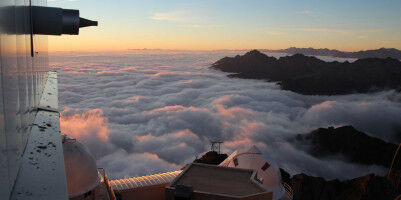
On the Pic du Midi in the Pyrenees, researchers have analysed particulate matter, clouds and rainwater for traces of arsenic. Using newly developed measurement methods, they have elucidated the transport pathways of the environmental toxin in the atmosphere. Arsenic is a trace element that lies just below phosphorus - which is essential for all living organisms - in the periodic table.
Earth Sciences - Materials Science - 07.01.2025

Geophysicists at ETH Zurich are using models of the lower mantle to identify areas where earthquake waves behave differently than previously assumed. This indicates the presence of zones of rocks that are colder, or have a different composition, than the surrounding rocks. This finding challenges our current understanding of the Earth's plate tectonics - and presents the researchers with a major mystery.
Environment - Earth Sciences - 19.12.2024

The search for the world's oldest ice in Antarctica is entering a decisive phase. In this major European project, researchers in Antarctica are attempting to extract drill cores containing climate information from the past 1.5 million years. The University of Bern is playing an important role in this.
Earth Sciences - Campus - 16.12.2024

By studying sulphur in magmatic fluids at extreme pressures and temperatures, a team from the University of Geneva is revolutionising our understanding of gold transport and ore deposit formation. When one tectonic plate sinks beneath another, it generates magmas rich in volatiles such as water, sulphur and chlorine.
Environment - Earth Sciences - 04.12.2024
CLOUD experiment resolves puzzle of new aerosol particles in upper troposphere
In a paper published today in the journal Nature , the CLOUD collaboration at CERN reveals a new source of atmospheric aerosol particles that could help scientists to refine climate models. Aerosols are microscopic particles suspended in the atmosphere that arise from both natural sources and human activities.


