


Complications after surgery are often difficult to detect. A project led by Empa researcher Inge Herrmann is now being supported by the Werner Siemens Foundation. Thanks to millions in funding over the next five years, her team at the labs at Balgrist University Hospital in Zurich is developing a novel contrast agent that continuously monitors surgical sites deep within the body - and even treats them in an emergency.
A surgical wound that heals poorly; an infection that develops slowly: Such complications often go unnoticed. Although medicine has made enormous progress, it is still difficult to observe what is happening inside the body - especially at the molecular level and in real time.
Empa researcher Inge Herrmann, head of the Ingenuity Lab at Balgrist University Hospital in Zurich, professor at medical faculty of the University of Zurich and lecturer at ETH Zurich, wants to change that. Together with her team, she is developing a technology as part of the SonoGuard project that will enable such deep-seated complications to be detected early on without surgery - and even treated. The Werner Siemens Foundation is supporting this innovative project with eight million Swiss francs over the next five years.
"Complications following medical procedures cause over four million deaths worldwide every year," says Herrmann. Such undesirable outcomes are particularly serious and difficult to detect when they occur inside the body.
One example is surgery on the gastrointestinal tract. Such procedures carry a high risk that the suture site will not heal properly and will leak. As a result, gastric and intestinal juices can enter the abdominal cavity and cause serious infections, including life-threatening blood poisoning (sepsis). By the time the danger is detected using conventional methods, valuable time has been lost, and the infection may already be well advanced.
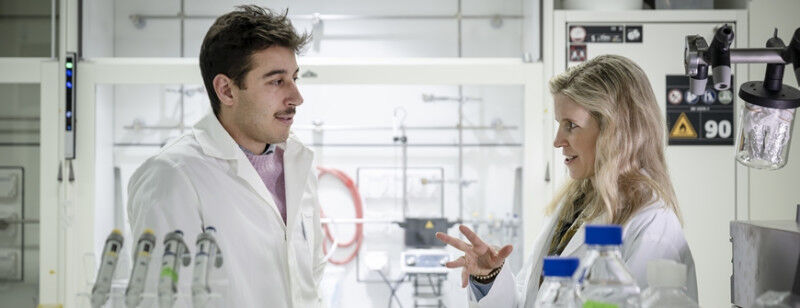
In the SonoGuard project, Inge Herrmann, doctoral candidate Benjamin Suter, and their team are now developing a new contrast agent that only becomes active when complications arise and can be activated and monitored using ultrasound. In addition, therapeutic agents are to be integrated into the contrast agent. "We are therefore combining the early warning system with a non-invasive treatment," says Inge Herrmann. A patent process is currently underway for components and developments within the project.
In an earlier project, the researchers developed a biocompatible hydrogel plaster with an adhesive strength up to ten times higher than that of conventional adhesive materials. It is suitable for sealing surgical wounds securely - and the contrast agent could also be integrated. "We can build on a lot," she says. The techniques developed for
SonoGuard is not only targeting intestinal surgery, but also other postoperative complications - such as those associated with the insertion of artificial knee or hip joints. There is also a lack of reliable early detection methods for these implant-associated infections - and the SonoGuard system could also be suitable for them.


