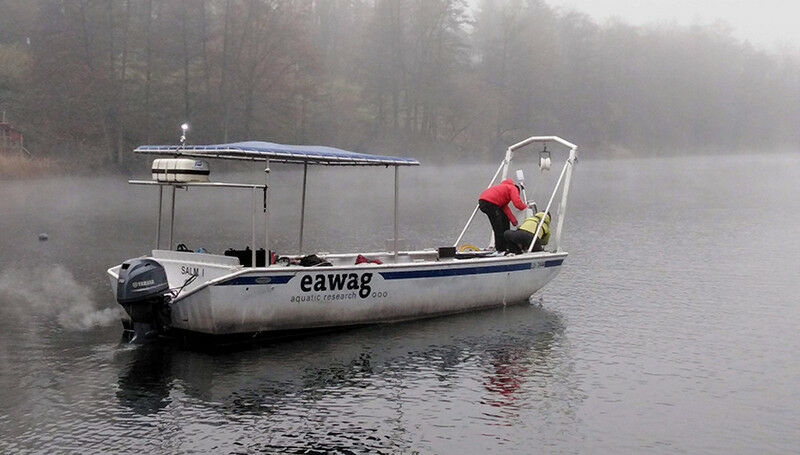
On a boat and a platform in Lake Rotsee, the Eawag research group carried out extensive measurements on the transport of gases in lake water (Photo: Tomy Doda, Eawag).
On a boat and a platform in Lake Rotsee, the Eawag research group carried out extensive measurements on the transport of gases in lake water (Photo: Tomy Doda, Eawag). At night or during cold winter days, lake water cools faster near the shore than in the middle of the lake. This creates a current that connects the shallow shore region with the deeper part of the lake. An international team led by researchers were able to show for the first time that this horizontal circulation transports gases such as oxygen and methane. The lake shore is directly affected by human activities: people swim and fish, river water enters the lake and wastewater can discharge pollutants. Until now, it was commonly assumed that a compound released at the shore is distributed slowly across the lake and breaks down at the same time, so that in the end it is only concentrated weakly and is barely detectable in deep lake water. "In our project, we show that this is by no means always true," says Tomy Doda, a scientist from the Aquatic Physics group of Damien Bouffard at Eawag and lead author of the study: "If there is a current connecting the shore region with the middle of the lake, the compound is transported much faster and doesn't have time to dilute and disintegrate completely before it reaches the deeper lake region." In the case of a pollutant, this can have negative consequences for the lake ecosystem.
POUR LIRE CET ARTICLE, CRÉEZ VOTRE COMPTE
Et prolongez votre lecture, gratuitement et sans engagement.