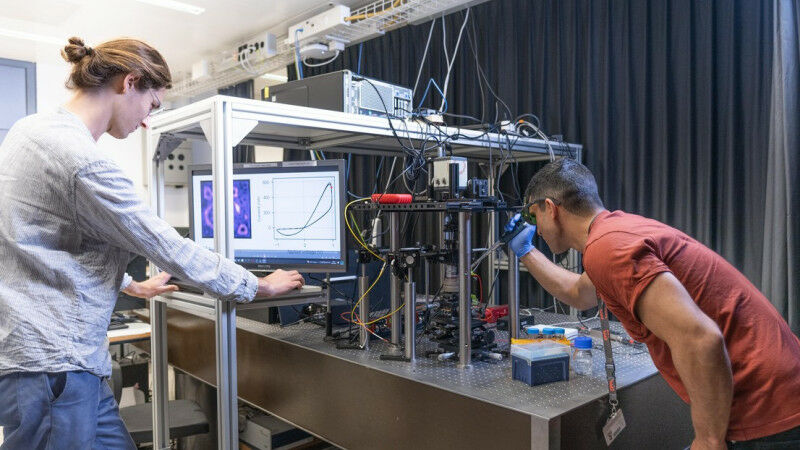
 Co-authors Nathan Ronceray and Théo Emmerich
Co-authors Nathan Ronceray and Théo Emmerich © Titouan Veuillet / EPFL CC BY SA In a step toward nanofluidic-based neuromorphic - or brain-inspired - computing, EPFL engineers have succeeded in executing a logic operation by connecting two chips that use ions, rather than electrons, to process data. Memory, or the ability to store information in a readily accessible way, is an essential operation in computers and human brains. A key difference is that while brain information processing involves performing computations directly on stored data, computers shuttle data back and forth between a memory unit and a central processing unit (CPU). This inefficient separation (the von Neumann bottleneck) contributes to the rising energy cost of computers. Since the 1970s, researchers have been working on the concept of a memristor (memory resistor); an electronic component that can, like a synapse, both compute and store data. But Aleksandra Radenovic in the Laboratory of Nanoscale Biology ( LBEN ) in EPFL's School of Engineering set her sights on something even more ambitious: a functional nanofluidic memristive device that relies on ions, rather than electrons and their oppositely charged counterparts (holes). Such an approach would more closely mimic the brain's own - much more energy efficient - way of processing information.
TO READ THIS ARTICLE, CREATE YOUR ACCOUNT
And extend your reading, free of charge and with no commitment.
Your Benefits
- Access to all content
- Receive newsmails for news and jobs
- Post ads