







news
Earth Sciences
Results 61 - 80 of 277.
Environment - Earth Sciences - 08.04.2024

More than 300,000 meteorites lie on the Antarctic ice. They contain an unprecedented wealth of information about our solar system. With every tenth of a degree of global warming, thousands of meteorites sink. Researchers from WSL and ETH recommend that their collection be promoted. The Antarctic holds a valuable treasure of around 300,000 meteorites lying on the surface of the ice.
Astronomy & Space - Earth Sciences - 05.04.2024
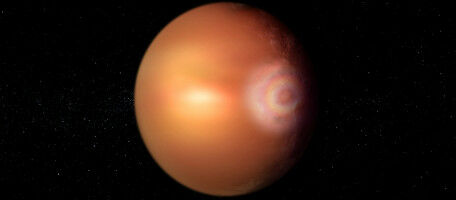
New observations from the space telescope point to the existence of a 'glory' in the atmosphere of WASP-76b, a luminous phenomenon like a rainbow. The CHEOPS space telescope, whose scientific operations centre is based at the University of Geneva , is providing new information on the mysterious exoplanet WASP-76b.
Environment - Earth Sciences - 02.04.2024

Researchers at ETH Zurich led by Robert Boes are developing specific solutions to optimise electricity production from Swiss hydropower plants. This will ensure that hydropower remains the backbone of Switzerland's electricity supply in the future. "Although Swiss hydropower is a proven technology, we must constantly work on optimising it.
Environment - Earth Sciences - 25.03.2024

Environmental scientist Alice Pradel cultivates ice cores in the lab to investigate the transport and accumulation of microand nanoplastics. Her aim in doing so is to better understand material flows in the Arctic ice. "Beat the Microbead" is the name of a campaign launched in 2012 with the aim of reducing the use of microplastics in cosmetic products in order to minimise negative effects on the environment and people.
Earth Sciences - Environment - 20.03.2024

Researchers at ETH Zurich have succeeded in detecting heavy precipitation events directly with GPS data. The results of their study could significantly improve meteorological monitoring and forecasting. An exceptionally severe storm swept over Zurich on 13 July 2021 shortly before 2 a.m.: howling squalls, constant lightning and torrential rain woke people up with a start.
Environment - Earth Sciences - 19.03.2024

An artificial intelligence system developed at EPFL can produce 3D maps of coral reefs from camera footage in just a few minutes. It marks a major leap forward in deep-sea exploration and conservation capabilities for organizations like the Transnational Red Sea Center (TRSC). Corals often provide a colorful backdrop to photographs of shimmering fish captured by amateur divers.
Environment - Earth Sciences - 06.03.2024

Engineers from EPFL and partner organizations have developed a method for classifying lacustrine deltas based on morphological parameters, in order to determine which of the deltas severely altered by human activity are best suited for restoration to their natural state. The Reuss delta on the edge of Lake Lucerne is once again a nature-lover's paradise, complete with gravel islands and stretches of shallow water where plants, animals and bathers coexist in harmony.
Astronomy & Space - Earth Sciences - 28.02.2024
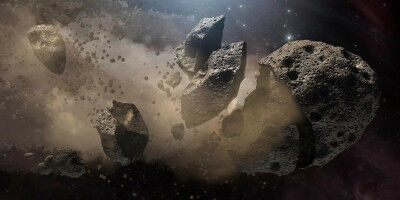
It might be that what set prebiotic chemistry in motion and kept it going in the early days of the Earth was dust from outer space accumulating in holes melted into ice sheets. Researchers at ETH Zurich and the University of Cambridge have used a computer model to test this scenario. Before life existed on Earth, there had to be chemistry to form organic molecules from the chemical elements nitrogen, sulphur, carbon and phosphorus.
Astronomy & Space - Earth Sciences - 26.02.2024

Physicists at ETH Zurich and the University of Zurich wanted to know whether the planned LIFE space mission could really detect traces of life on other planets. Yes, it can. The researchers reached this conclusion with the help of observations of our own planet. Life is indeed possible on Earth. This has been demonstrated in a study conducted by the Institute of Particle Physics and Astrophysics at ETH Zurich.
Earth Sciences - Environment - 12.02.2024

Climate changes usually happens over long periods of time, but during the last glacial period, extreme fluctuations in temperature occurred within just a few years. Researchers at the University of Basel have now been able to prove the phenomenon also occurred during the penultimate glacial period. In recent geological history, the so-called Quaternary period, there have been repeated ice ages and warm periods.
Astronomy & Space - Earth Sciences - 09.02.2024
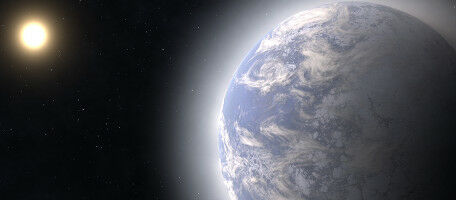
Exoplanets with a radius twice that of the Earth are rare. A team from MPIA, UNIGE and UNIBE has come up with new explanations. Why are so few exoplanets about twice the size of Earth detected? On the basis of computer simulations, a team from the Max Planck Institute for Astronomy (MPIA) and the Universities of Geneva (UNIGE) and Bern (UNIBE) has confirmed that the migration of sub-Neptunes planets - water-worlds - could explain this absence.
Environment - Earth Sciences - 08.02.2024

Madagascar is home to over 11,000 plant species, 80 percent of which are found nowhere else on Earth. A recent study by the Swiss Federal Institute for Forest, Snow and Landscape Research WSL and ETH Zurich has put forward a new hypothesis for the underlying cause of Madagascar's rich plant biodiversity, which has been regarded as an unsolved mystery of natural history.
Earth Sciences - 08.02.2024
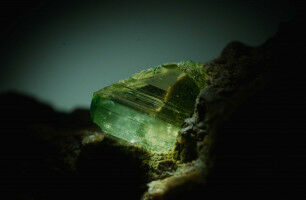
Hardly any gemstone is more difficult to find than diamonds. Geologists from ETH Zurich and the University of Melbourne have now established a link between their occurrence and the mineral olivine. This could make the search for diamonds easier in the future. In brief The abundance of magnesium and iron in the mineral olivine provides information on whether or not diamonds could be present in a kimberlite rock sample.
Environment - Earth Sciences - 26.01.2024

As a journalist, do you have general questions about PSI? Are you looking for an expert on your topic? Get in touch with our In the flying laboratory Every year, the National Emergency Operations Centre (NEOC), with the support of PSI, carries out measuring flights to determine the radiological situation in Switzerland.
Environment - Earth Sciences - 25.01.2024

At night or during cold winter days, lake water cools faster near the shore than in the middle of the lake. This creates a current that connects the shallow shore region with the deeper part of the lake. An international team led by researchers were able to show for the first time that this horizontal circulation transports gases such as oxygen and methane.
Environment - Earth Sciences - 20.12.2023

Nearly a quarter of the Earth's land surface is permanently frozen. These areas, known as permafrost, are found in northern polar regions and at high altitudes.
Environment - Earth Sciences - 12.12.2023

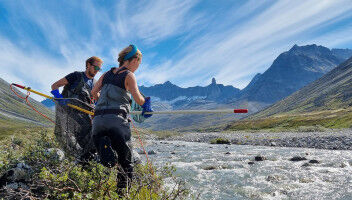
Field studies by Eawag researcher David Janssen in southern Greenland show that the heavy metals in the rivers are largely of natural origin, and that the influence of mining and agriculture is negligible, at least during the period observed. The rivers in Greenland can transport unusually high concentrations of heavy metals, including copper, zinc, gold, silver, platinum, lead and mercury.
Environment - Earth Sciences - 04.12.2023

With increasing temperatures, more heatwaves and less snowfall, glacier melt is accelerating. Whether we will still have water reserves in the form of frozen ice by 2100 depends heavily on efforts to contain the climate crisis.
Earth Sciences - Physics - 23.11.2023
Predicting earthquakes and tsunamis with fibre-optic networks
Geophysicists at ETH Zurich have shown that every single wave of a magnitude 3.9 earthquake registers in the noise suppression system of fibre-optic networks.
Astronomy & Space - Earth Sciences - 25.10.2023

Mars's liquid iron core is smaller and denser than previously thought. Not only is it smaller, but it is also surrounded by a layer of molten rock. This is what researchers conclude on the basis of seismic data from the InSight lander. For four years, NASA's InSight lander recorded tremors on Mars with its seismometer.


