


Intervention de Cynthia Kraus, dans le journal Le Temps, le 9 décembre 2025
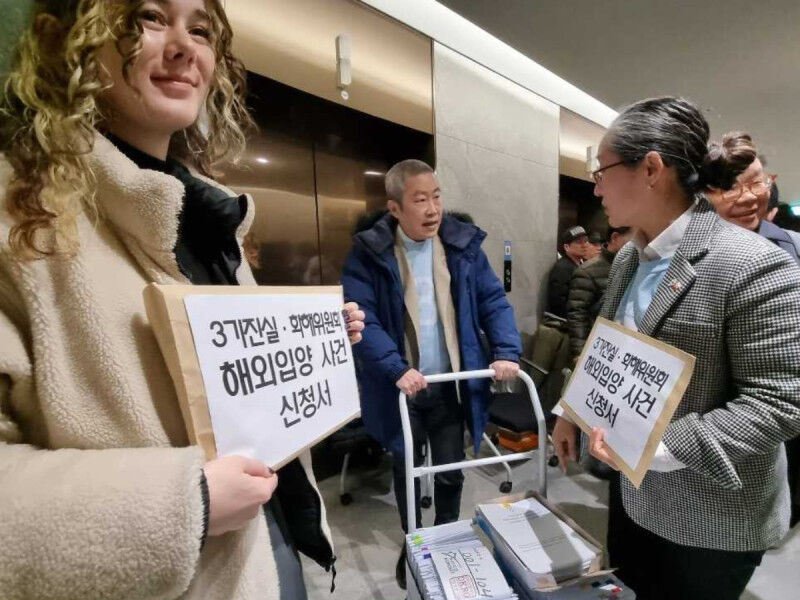
Le 26 février 2026, la troisième Commission vérité et réconciliation (TRC3) a officiellement ouvert ses travaux à Séoul, marquant une nouvelle étape dans l’examen des irrégularités liées aux adoptions internationales en provenance de Corée du Sud. À cette occasion, Peter Møller (au centre de la photo) et Boon Young Han (à droite de la photo), responsables du Danish Korean Rights Group (DKRG), ont déposé 311 nouvelles demandes auprès de la TRC3 au nom d’adopté·e·s coréen·ne·s (KADs) et de leurs descendant·e·s (DoKADs). Ces demandes visent à obtenir pour chaque cas un accès complet aux dossiers et informations personnelles, la clarification des procédures d’adoption, l’établissement des responsabilités en cas d’irrégularités et de violations des droits humains, ainsi que la reconnaissance institutionnelle de ces faits et l’accès à la justice. Les requérant·e·s proviennent de 15 pays-dont la Suisse-avec une augmentation notable des demandes émanant de l’espace francophone par rapport à la deuxième Commission (TRC2). Le « dossier n° 1 » de la TRC3 a été déposé par Marrit Kim van der Staaij (à gauche de la photo), DoKAD originaire des Pays-Bas et cofondatrice de DoKADstories. Elle a présenté cette demande au nom de sa mère décédée, soulignant la dimension intergénérationnelle de la quête de vérité et le droit des descendant·e·s d’accéder à des archives historiques fiables. Ces nouvelles demandes s’ajoutent aux dossiers déposés lors de la précédente commission (367 dossiers au total, dont 56 étudiés par la TRC2; les 311 dossiers restant seront examinés par la TRC3) et témoignent de la mobilisation internationale croissante des personnes adoptées et de leurs familles pour faire toute la lumière sur l’histoire des adoptions internationales et obtenir vérité, reconnaissance et justice.
Références et liens ci-dessous
On February 26, 2026, the Third Truth and Reconciliation Commission (TRC3) officially opened in Seoul, marking a new phase in the investigation of irregularities linked to international adoptions from South Korea. Peter Møller (center of the photo) and Boon Young Han, (right of the photo), leaders of the Danish Korea Rights Groups (DKRG), submitted 311 new applications to TRC3 on behalf of Korean adoptees (KADs) and their descendants (DoKADs). These applications demand: full access to truthful personal records, clarification of adoption procedures, accountability for potential irregularities and human rights violations; institutional recognition and justice. Applicants come from 15 different countries, including Switzerland, with a notable increase in French-speaking applicants compared to the second Commission (TRC2). -Case no. 1- was submitted by Marrit Kim (left of the photo), a DoKAD from the Netherlands and co-founder of DoKAD.archive and DoKADstories. She filed her application on behalf of her late mother, underscoring the intergenerational dimension of truth-seeking and the right of descendants to access accurate historical records. These new applications build on the cases submitted to the previous commission (367 in total, of which 56 were investigated by TRC2; the remaining 311 will now be examined by TRC3). They reflect the growing international mobilization of adoptees and their families to bring the full history of international adoptions to light and to seek truth, recognition, and justice.
References and links below
Extrait de l’article
2nd Truth and Reconciliation Commission (TRC2), Republic of Korea. 2025. Human Rights Violation in Intercountry Adoption
