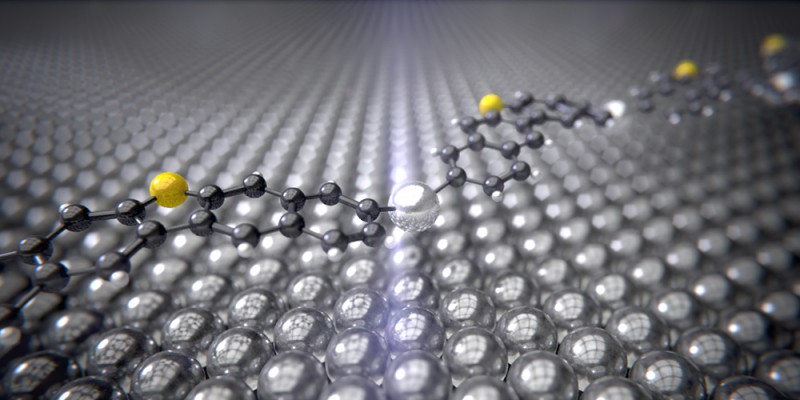
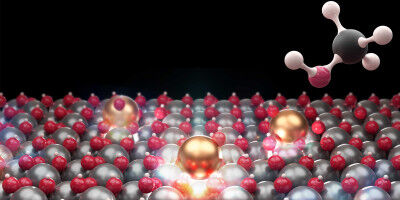
The intermediate product of the Ullmann reaction with the silver catalyst (silver) between the carbon rings (black) and sulfur atoms (yellow) curves like a bridge over the silver surface. (Image: University of Basel, Department of Physics)
Physicists at the University of Basel have succeeded in watching a silver catalyst at work for the first time with the aid of an atomic force microscope. The observations made during an Ullmann reaction have allowed the researchers to calculate the energy turnover and, potentially, to optimize the catalysis. The study, which was performed with experts from Japan and Iran, has been published in the scientific journal "Small". The Ullmann reaction examined is a chemical reaction in which silver atoms catalyze the bond between two carbon atoms to which iodine was previously bonded. Although scientists have known about this type of reaction since 1901 and used it for many important chemical conversions, it was not previously possible to observe the intermediate product of the reaction in detail. Using an atomic force microscope, the team of researchers led by Professor Ernst Meyer and Dr. Shigeki Kawai from the Swiss Nanoscience Institute and the Department of Physics at the University of Basel has now succeeded in displaying this reaction at atomic resolution. Surprisingly, it was revealed that the silver atoms react with the molecules at temperatures of around -120 °C and seem to curve like a bridge over a river.
POUR LIRE CET ARTICLE, CRÉEZ VOTRE COMPTE
Et prolongez votre lecture, gratuitement et sans engagement.