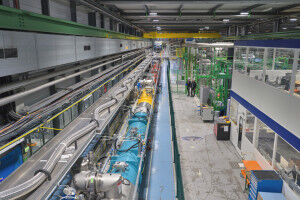
The TCV Tokamak at EPFL’s Swiss Plasma Center
The TCV Tokamak at EPFL's Swiss Plasma Center © A. Herzog / EPFL - The core of a fusion reactor is incredibly hot. Hydrogen that inevitably escapes from it must be cooled on its way to the wall, as otherwise, the reactor wall would be damaged. Researchers from the Dutch institute DIFFER and EPFL's Swiss Plasma Center have developed a strict measurement and control method for the cooling of very hot particles escaping from fusion plasmas. Fusion energy is a promising sustainable energy source. In a fusion reactor, extremely hot hydrogen plasma is kept suspended by magnetic fields. However, there is always a fraction that escapes. To prevent it from damaging the reactor vessel, the escaped hydrogen must be cooled down on its way to the wall. Cooling can be achieved in various ways, such as by injecting a gas. "But if you inject too much additional gas, the plasma is cooled too strongly, which reduces the performance," says Christian Theiler (Swiss Plasma Center, EPFL), co-author of a study published.
TO READ THIS ARTICLE, CREATE YOUR ACCOUNT
And extend your reading, free of charge and with no commitment.
Your Benefits
- Access to all content
- Receive newsmails for news and jobs
- Post ads