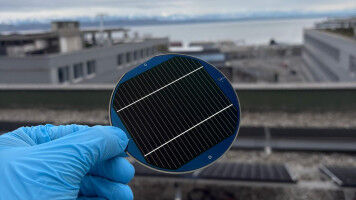
Highly luminescent and stable alpha-FAPbI3 perovskite via HCOO- anion engineering. Credit: Jin Young Kim (UNIST)
Highly luminescent and stable alpha-FAPbI3 perovskite via HCOO- anion engineering. Credit: Jin Young Kim (UNIST) - Physical chemists and chemical engineers led by EPFL have used a chemical tweak to push the power-conversion efficiency and operational stability of perovskite solar cells to 25.6% and at least 450 hours respectively. Perovskites are hybrid compounds that can be made from metal halides and organic constituents. Their attractive structural and electronic properties have placed them at the forefront of materials' research, with enormous potential for transforming a wide range of applications, including in solar cells, LED lights, lasers, and photodetectors. Metal-halide perovskites in particular show great potential as light harvesters for thin-film photovoltaics. One of the leading candidates among metal halide perovskites is formamidinium lead triiodide (FAPbI3), which has emerged as the most promising semiconductor for highly efficient and stable perovskite solar cells. Consequently, scientists have been trying to maximize its performance and stability.
TO READ THIS ARTICLE, CREATE YOUR ACCOUNT
And extend your reading, free of charge and with no commitment.