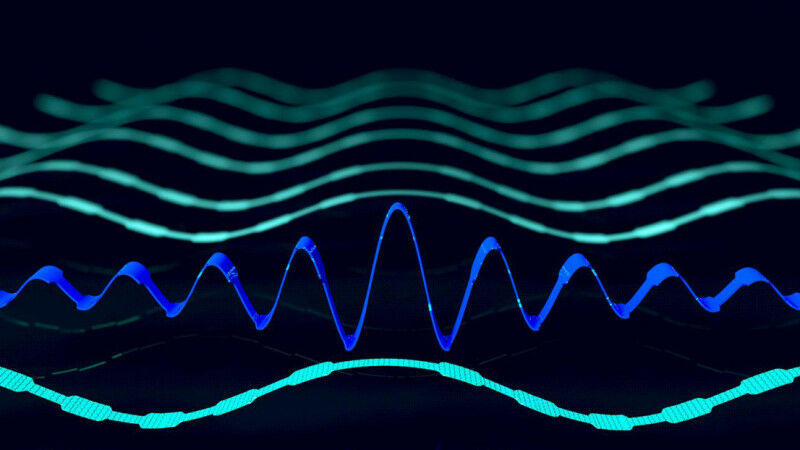
Artist’s rendition of the vibration patterns of nanoscale crystalline silicon strings. Credit: Daniele Francaviglia
Artist's rendition of the vibration patterns of nanoscale crystalline silicon strings. Credit: Daniele Francaviglia - A team of scientists engineer nanoscale guitar strings that vibrate tens of billions of times when plucked at cryogenic temperatures, with a material originally developed for electronic transistors. Tightening a string, e.g. when tuning a guitar, makes it vibrate faster. But when strings are nano-sized, increased tension also reduces, or -dilutes-, the loss of the string's vibrational modes. This effect, known as -dissipation dilution-, has been exploited to develop mechanical devices for quantum technologies, where engineered, tensioned nanostrings with a thickness of just a few tens of atomic layers oscillate more than ten billion times after being plucked just once. The equivalent on a guitar would be a chord heard for about a year after being plucked. Researchers at EPFL, led by Professor Tobias J. Kippenberg, have now made a simple observation about crystal oscillators, which are ubiquitously used in electronic devices and are known to possess extremely small mechanical energy loss at low temperature.
TO READ THIS ARTICLE, CREATE YOUR ACCOUNT
And extend your reading, free of charge and with no commitment.