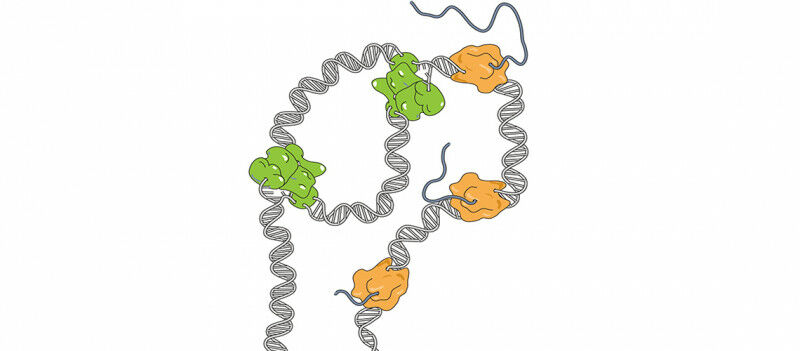
 The image shows collisions of the replication and transcription machineries on DNA. These collisions are prevented by the PARP1 enzyme, whose inhibition is exploited for treatment of select breast and ovarian cancers.
By showing how a type of anticancer drug kills cancer cells and damages healthy cells, a team from the University of Geneva is paving the way for improved treatments. The image shows collisions of the replication and transcription machineries on DNA. These collisions are prevented by the PARP1 enzyme, whose inhibition is exploited for treatment of select breast and ovarian cancers. Nicolas Roggli and Thanos Halazonetis Some anti-cancer treatments not only target tumour cells but also healthy cells. If their effects on the latter are too strong, their use can become limiting. A team from the University of Geneva , in collaboration with Basel-based FoRx Therapeutics, has identified the mechanism of action of PARP inhibitors, used in particular for breast and ovarian cancer in patients carrying the BRCA gene mutation. These inhibitors block two specific activities of the PARP proteins.
UM DIESEN ARTIKEL ZU LESEN, ERSTELLEN SIE IHR KONTO
Und verlängern Sie Ihre Lektüre, kostenlos und unverbindlich.
Ihre Vorteile
- Zugang zu allen Inhalten
- Erhalten Sie Newsmails für Neuigkeiten und Jobs
- Anzeigen veröffentlichen