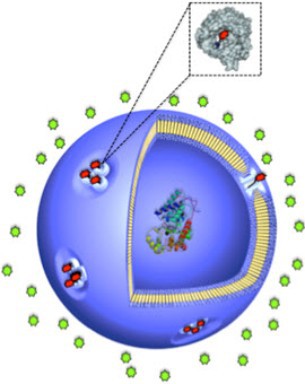
Nanovesicle with closed protein gates (red).
Researchers at the University of Basel have succeeded in building protein gates for artificial nano-vesicles that become transparent only under specific conditions. The gate responds to certain pH values, triggering a reaction and releasing active agents at the desired location. This is demonstrated in a study published in the journal Nano Letters. Tiny nanovesicles can protect active agents until they arrive in specific environments, such as at the target site in the body. In order to trigger a chemical reaction and release the contents at that loca-tion, the outer casing of the synthetically produced vesicles must become permeable at the correct point in time. Working under Prof. Cornelia Palivan, researchers from the Swiss Nanoscience Insti-tute have now developed a membrane gate that opens on demand. This means that the enzymes inside a nanocapsule become active under exactly the right conditions and act on the diseased tissue directly.
PER LEGGERE QUESTO ARTICOLO, CREA IL TUO ACCOUNT
Ed estendere la vostra lettura, gratuitamente e senza alcun impegno.