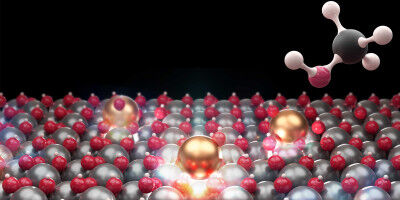
Graphene nanoribbon under the microscope. © University of Basel
Physicists at the University of Basel succeed in synthesizing boron-doped graphene nanoribbons and characterizing their structural, electronic and chemical properties. The modified material could potentially be used as a sensor for the ecologically damaging nitrogen oxides, scientists report . Graphene is one of the most promising materials for improving electronic devices. The two-dimensional carbon sheet exhibits high electron mobility and accordingly has excellent conductivity. Other than usual semiconductors, the material lacks the so-called band gap, an energy range in a solid where no electron states can exist. Therefore, it avoids a situation in which the device is electronically switched off. However, in order to fabricate efficient electronic switches from graphene, it is necessary that the material can be switched "on" and "off".
UM DIESEN ARTIKEL ZU LESEN, ERSTELLEN SIE IHR KONTO
Und verlängern Sie Ihre Lektüre, kostenlos und unverbindlich.
Ihre Vorteile
- Zugang zu allen Inhalten
- Erhalten Sie Newsmails für Neuigkeiten und Jobs
- Anzeigen veröffentlichen