

A new combination of data and statistical algorithms makes it possible for the first time to precisely track the movements of animals deep underwater. An initial study of flapper skate on the seabed around Scotland will help to develop targeted measures to conserve these Critically Endangered animals and designate suitable protected areas. The results have now been published in Science Advances.
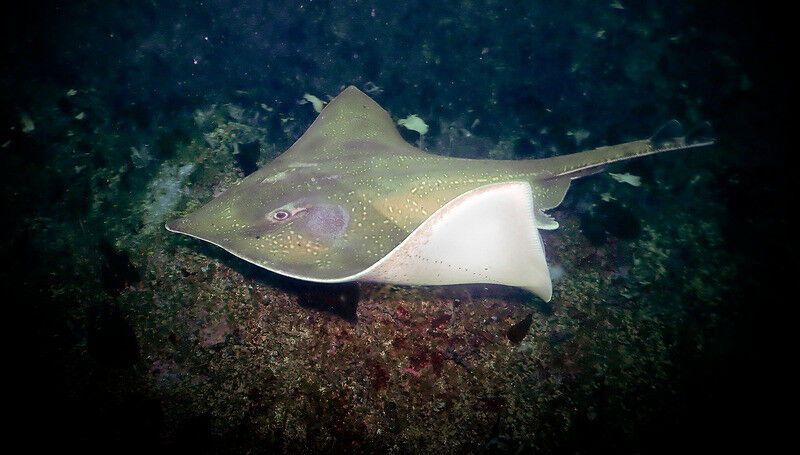
Flapper skate (Dipturus intermedius), the world’s largest skate species measuring over two metres in length, live hidden on the rugged seabed around Scotland. Their life in the darkness, deep underwater, makes it extremely difficult to find out more about their whereabouts and movements. However, there is considerable interest in these animals. As predatory fish at the top of the marine food web, they play a very important role in marine habitats and the balance of marine ecosystems.
However, due to overfishing, skates and their close relatives the sharks, are among the most endangered vertebrates on the planet. This makes it all the more important to conserve the remaining populations and support their recovery. To do this, it is essential to know where they live. However, the approaches currently used to track animal movements quickly reach their limits underwater.
Lighting up the darkness of the seabed
Now, an interdisciplinary team of researchers has succeeded in shedding further light on the lives of animals in the deep using a new combination of data and statistical methods. The results were recently published in Science Advances. In this study, the research team applied the methods to flapper skate in the Loch Sunart to the Sound of Jura Marine Protected Area on the west coast of Scotland. They were able to track the movements of these animals with unprecedented accuracy and map their locations over the seabed.
The mapping shows that skate frequently inhabit the protected area and should benefit from the fishing restrictions in this region. The researchers were also able to locate other hotspots outside the protected area used by skate. Additional protective measures could be beneficial in these areas.
The paper was led and funded by the Eawag aquatic research institute based on data collected by the Movement Ecology of Flapper Skate project. It brought together a diverse team of researchers from the fields of biology, statistics, physics, mathematics and ocean modelling, as well as experts in nature conservation and policymakers from leading research institutes, nature conservation authorities and government:
- Edinburgh Napier University
- University of St Andrews
- University of Glasgow
- Scottish Association for Marine Science
- Royal Zoological Society of Scotland
- University of Surrey
- NatureScot
- Marine Directorate
The study is based on data from projects funded by:
- Marine Directorate
- NatureScot
- Marine Alliance for Science and Technology for Scotland