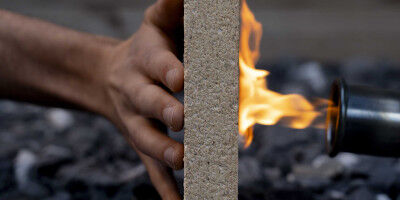
© Samuel Howell / 2020 EPFL EPFL researchers have developed a high-precision technology that enables them to carve nanometric patterns into two-dimensional materials. With their pioneering nanotechnology, EPFL researchers have achieved the impossible. They can now use heat to break the links between atoms with a miniature scalpel. "It's extremely hard to structure 2D materials using conventional lithography, which often employs aggressive chemicals or accelerated, electrically charged particles, like electrons or ions, that can damage the material's properties," says Xia Liu, a researcher and postdoc in the School of Engineering's Microsystems Laboratory. "Our technique, however, uses a localized heat and pressure 'source' to accurately cut into the 2D materials." "Our technology is similar to the art of paper-cutting, which is common in this region of Switzerland, but on a much smaller scale," explains Ana Conde Rubio, co-author of the study. "We use heat to modify the substrate and make it more flexible and, in some cases, even turn it into a gas. We can then more easily carve into the 2D material." A sharp tip Xia Liu, Samuel Howell, Ana Conde Rubio, Giovanni Boero and Jürgen Brugger used molybdenum ditelluride (MoTe
2), a 2D material that's similar to graphene.
PER LEGGERE QUESTO ARTICOLO, CREA IL TUO ACCOUNT
Ed estendere la vostra lettura, gratuitamente e senza alcun impegno.
I vostri vantaggi
- Accesso a tutti i contenuti
- Ricevere newsmail per le novità e le offerte di lavoro
- Pubblicare annunci