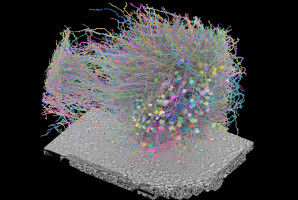
Neurons and Glia cells in Drosophila larval ventral nerve cord (spinal cord analog). Credit: B. McCabe (EPFL)
Neurons and Glia cells in Drosophila larval ventral nerve cord (spinal cord analog). Credit: B. McCabe (EPFL) - Thanks to genetic tools that allow computers to accurately count neurons from microscopy images, researchers have estimated with unprecedented accuracy the number of neurons and other types of cells in the brain of fruit fly larvae-and discovered that females have substantially more neurons than males. Determining the number of cells in the brain is key to the study of brain structure and function. But counting neurons from microscopy images is time-consuming, and the human eye is easily exhausted. To overcome this problem, researchers typically slice up brain tissue and then count the number of cells in one section to estimate the total number of neurons in the brain. But these methods are error-prone, because they assume that the number of neurons or other cells is the same throughout the brain. Now, scientists have developed a new approach to identify cells with superhuman accuracy and speed in the intact brain of a Drosophila (fruit fly) larva, an important neuroscience model organism.
TO READ THIS ARTICLE, CREATE YOUR ACCOUNT
And extend your reading, free of charge and with no commitment.