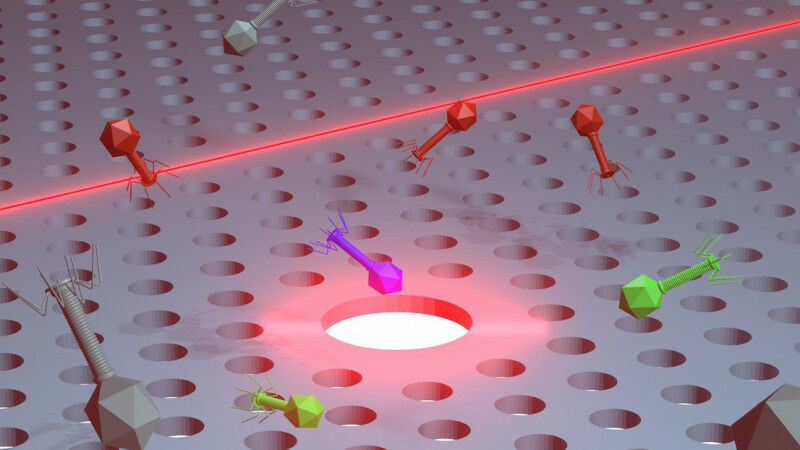
An illustration of the chip-embedded nanotweezers trapping bacteriophages. Credit: Nicolas Villa/EPFL
An illustration of the chip-embedded nanotweezers trapping bacteriophages. Credit: Nicolas Villa/EPFL Scientists at EPFL have developed a game-changing technique that uses light to manipulate and identify individual bacteriophages without the need for chemical labels or bioreceptors, potentially accelerating and revolutionizing phage-based therapies that can treat antibiotic-resistant bacterial infections. With antibiotic resistance looming as a formidable threat to our health, scientists are on a constant quest for alternative ways to treat bacterial infections. As more and more bacterial strains outsmart drugs we have been relying on for decades, a possible alternative solution may be found in bacteriophages, which are viruses that prey on bacteria. Phage therapy, the use of bacteriophages to combat bacterial infections, is gaining attraction as a viable alternative to traditional antibiotics. But there is a catch: finding the right phage for a given infection is like searching for a needle in a haystack, while current methods involve cumbersome culturing, time-consuming assays. Now, scientists at EPFL, in collaboration with the CEA Grenoble and the Lausanne University Hospital (CHUV) have developed on-chip "nanotweezers" that can trap and manipulate individual bacteria and virions (the infectious form of a virus) using a minimal amount of optical power.
TO READ THIS ARTICLE, CREATE YOUR ACCOUNT
And extend your reading, free of charge and with no commitment.