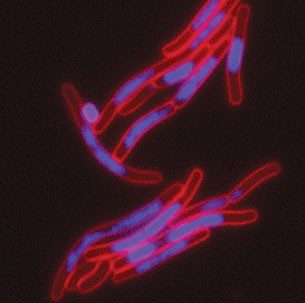
 FIC toxins modify the spatial structure of the DNA (blue) of bacteria (red: cell membrane). © University of Basel, Biozentrum
Bacteria do not cease to amaze us with their survival strategies. A research team from the University of Basel's Biozentrum has now discovered how bacteria enter a sleep mode using a so-called FIC toxin. In the current issue of "Cell Reports", the scientists describe the mechanism of action and also explain why their discovery provides new insights into the evolution of pathogens. For many poisons there are antidotes which neutralize their toxic effect. Toxin-antitoxin systems in bacteria work in a similar manner: As long as a cell produces an antitoxin, thereby neutralizing a particular toxin, it grows normally. If the antitoxin is degraded, triggered for example by adverse environmental conditions, the toxin becomes effective and inhibits important cellular processes. These systems act like a switch that interferes with bacterial growth and sends the bacteria into a state of dormancy in which they can be protected from the action of antibiotics.
UM DIESEN ARTIKEL ZU LESEN, ERSTELLEN SIE IHR KONTO
Und verlängern Sie Ihre Lektüre, kostenlos und unverbindlich.
Ihre Vorteile
- Zugang zu allen Inhalten
- Erhalten Sie Newsmails für Neuigkeiten und Jobs
- Anzeigen veröffentlichen