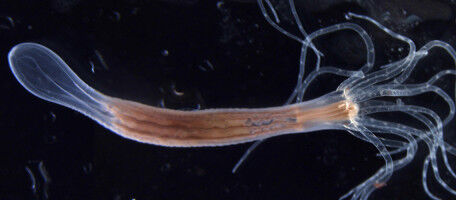
Examples of protrusions formed by confinement of muscle cells on adhesive discs. The disc, slightly larger than the diameter of the protrusion, is visible at the base. On some protrusions, the vortex organization is visible. The twisted shape of other protrusions is also indicative of rotational forces. (c) UNIGE
Examples of protrusions formed by confinement of muscle cells on adhesive discs. The disc, slightly larger than the diameter of the protrusion, is visible at the base. On some protrusions, the vortex organization is visible. The twisted shape of other protrusions is also indicative of rotational forces. (c) UNIGE - A team from the UNIGE has demonstrated that cells self-organise to generate forces that model the shapes of our tissues. How are the different shapes of our organs and tissues generated? To answer this question, a team from the University of Geneva , Switzerland, forced muscle cells to spontaneously reproduce simple shapes in vitro . By confining them on adhesion discs, the biochemists and physicists observed that the cells rapidly self-organise by aligning themselves in the same direction. A circular motion is created around a vortex - called a topological defect - which, by orienting the cells, allows them to join forces, deforming the cell monolayer into a protrusion, a structure commonly observed in embryo development. This cylindrical protrusion is maintained by the collective rotational forces of the cells, creating a tornado-like effect. The formation of these cellular tornadoes would therefore constitute a simple mechanism of spontaneous morphogenesis, dictated by the unique properties of multicellular assemblies. These results can be read . Our bodies are made up of organs and tissues, each with its peculiar shape. But how do cells manage to form the folds of the intestine or the alveoli of the lungs?
TO READ THIS ARTICLE, CREATE YOUR ACCOUNT
And extend your reading, free of charge and with no commitment.