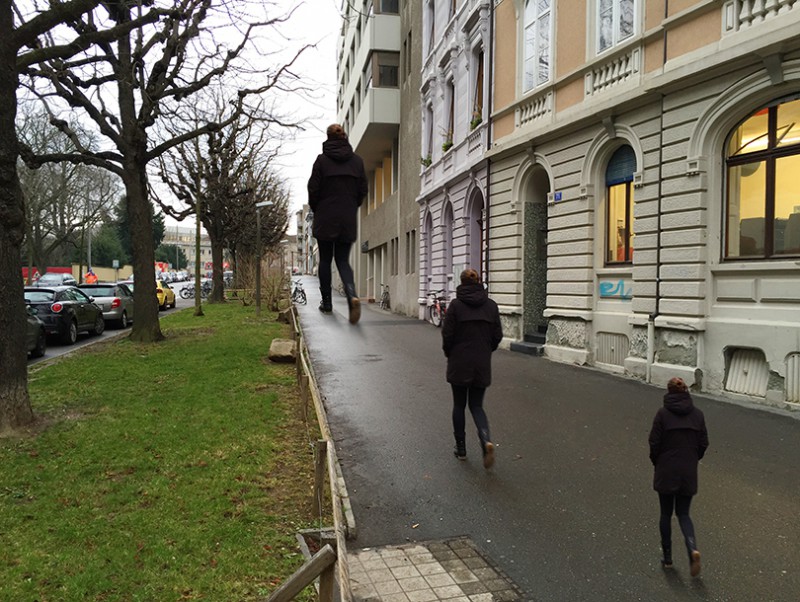
 This optical illusion shows how strongly the context of a visual scene influences what we see, and how this context can sometimes mislead us. The three people in the picture are exactly the same size. However, our brain judges the size of an object based on its perceived distance. The person at the back seems to be further away and therefore appears larger.
The Thalamus not only relays visual signals from the eye to the visual cortex as previously thought, but also conveys additional, contextual information. Integrating these different signals is essential to understand and interpret what we see in the world around us. Prof. Sonja Hofer and her research team at the Biozentrum, University Basel, investigate how the brain processes visual stimuli and how contextual information shapes our visual perception. Their latest findings are reported in "Nature Neuroscience". As soon as we open our eyes in the morning, our brain is flooded with images. Information about these images is sent from the eyes to a brain region called the thalamus, and from there on to the visual cortex. The visual cortex, which comprises the largest part of the human brain, is responsible for analyzing visual information and allows us to see.
TO READ THIS ARTICLE, CREATE YOUR ACCOUNT
And extend your reading, free of charge and with no commitment.
Your Benefits
- Access to all content
- Receive newsmails for news and jobs
- Post ads