Generating oxygen from sunlight, water and semiconducting polymers
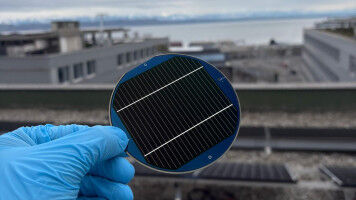
Generating oxygen from sunlight, water and semiconducting polymers © LIMNO / EPFL - Scientists are generating oxygen from sunlight, water and semiconducting polymers. They present a promising way towards economical and scalable solar fuel production. Natural photosynthesis evolved to covert water and sunlight into oxygen (O
2) and stored chemical energy. In plants this process is not very efficient, however the possibility to convert sunlight into chemical fuel in an economical and globally scalable manner is a very attractive method for reducing our dependence on fossil fuels. As such, scientists have been searching for routes toward efficient and inexpensive mimics of natural photosynthesis for decades. It turns out that the O
2 production step is quite tricky and remains a major challenge toward artificial photosynthesis. Now Prof. Kevin Sivula and his co-workers in the Laboratory for Molecular Engineering of Optoelectronic Nanomaterials (LIMNO) at EPFL describe a mixture of semiconducting polymers, commonly known as plastic electronics, that demonstrates highly efficient solar-driven water oxidation (H
2O - O
2).
PER LEGGERE QUESTO ARTICOLO, CREA IL TUO ACCOUNT
Ed estendere la vostra lettura, gratuitamente e senza alcun impegno.
I vostri vantaggi
- Accesso a tutti i contenuti
- Ricevere newsmail per le novità e le offerte di lavoro
- Pubblicare annunci