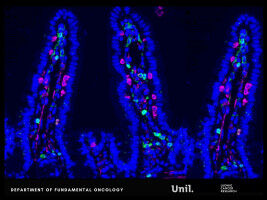
Representative image of 3D model of colorectal carcinoma (HCT116 cells) exposed for 72 hours to treatment with a three-drug combination containing regorafenib, erlotinib and 5-fluorouracil. The cell-tracker stained cells correspond to cell nuclei (blue), live cells (green) and dead cells (red).
UNIGE researchers have developed a cell co-culture platform that can reproduce a patient's tumour in 3D and test the best treatment combinations for its specific case in just five days. Why doesn't the same treatment work in the same way for every patient? How can a drug's performance be optimised without causing side effects due to an excessive dosage? In an attempt to answer these questions, researchers at the University of Geneva (UNIGE), Switzerland, have devised a cell co-culture platform that reproduces a patient's tumour structure in 3D. The scientists can use it to test several drugs or their combinations at different stages of the tumour's development. They now need only five days to identify which treatment will be most effective for a particular case, and the combination can then be translated for clinical practice. These results are highly promising for the future of personalised medicine, and you can read all about the outcomes in the journal Scientific Reports . Colorectal cancer is the third most common form of cancer diagnosed today and the fourth most deadly in the world: 1.4 million people are affected each year, with 700,000 fatalities. A range of treatments is available, including chemotherapy, but the high dosages cause numerous side effects and patients commonly develop resistance.
PER LEGGERE QUESTO ARTICOLO, CREA IL TUO ACCOUNT
Ed estendere la vostra lettura, gratuitamente e senza alcun impegno.
I vostri vantaggi
- Accesso a tutti i contenuti
- Ricevere newsmail per le novità e le offerte di lavoro
- Pubblicare annunci