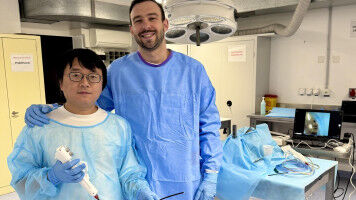
Dr Philip Koch and Friedhelm Hummel performing an MRI. Credit: F. Hummel (EPFL)
Dr Philip Koch and Friedhelm Hummel performing an MRI. Credit: F. Hummel (EPFL) - An international team of scientists led by EPFL has developed a system that combines information from the brain's connectome - the "wiring" between neurons - and machine learning to assess and predict the outcome of stroke victims. When blood flow to the brain is somehow reduced or restricted, a person can suffer what we know as a stroke (from "ischemic stroke" in medical jargon). Stroke is one of those conditions that seems fairly common. This isn't a misperception: just in Europe, there are over 1.5 million new cases each year. Some strokes can be lethal, and when they're not they often result in serious damage to the victim's ability to move. In fact, stroke is one of the major causes of long-term disability today.
PER LEGGERE QUESTO ARTICOLO, CREA IL TUO ACCOUNT
Ed estendere la vostra lettura, gratuitamente e senza alcun impegno.