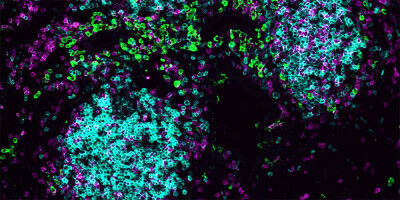
Under the influence of interferons, chronic viral infections cause strong inflammation. This causes the B cells to initiate an inadequate immune response which first optimizes the production of antibodies for a short period, but then rapidly subsides. (Image: University of Basel)
Scientists at the University of Basel discovered a fundamental new mechanism explaining the inadequate immune defense against chronic viral infection. These results may open up new avenues for vaccine development. They have been published in the journal 'Science Immunology'. In the course of an infection or upon vaccination, specialized cells of our immune system, so-called B cells, produce antibodies that bind viruses and inactivate them. In the context of chronic viral infections such as HIV or hepatitis C virus, however, antibody production by B cells is quantitatively inadequate and starts too late. A team of scientists headed by Prof. Daniel Pinschewer at the Department of Biomedicine, University of Basel, reports that the inadequate antibody response to chronic viral diseases is due to the strong inflammatory reaction upon infection. While most pronounced at the onset of an infection, inflammation can persist for decades, especially in HIV/AIDS.
PER LEGGERE QUESTO ARTICOLO, CREA IL TUO ACCOUNT
Ed estendere la vostra lettura, gratuitamente e senza alcun impegno.