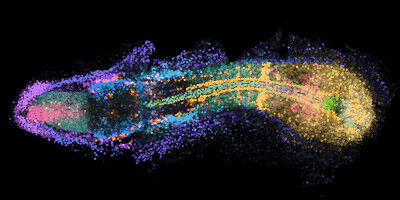
A yeast cell ’racing’ towards a stop. Credit: Nguyen Tâm Johan (EPFL)
A yeast cell 'racing' towards a stop. Credit: Nguyen Tâm Johan (EPFL) - How does a cell balance risk and speed when dividing? scientists have developed and experimentally tested the first mathematical theory that describes the cell's best strategy for dividing safely and efficiently. Cells go through a life cycle that includes growing to the right size, being equipped to perform its functions, and finally dividing into two new cells. The cell cycle is critical because it ensures the perpetuation of the cell population and by extension of the greater structure they are a part of - for example a tissue in the body. The cell cycle itself is tightly regulated by checkpoints, which prevent errors like mutations or DNA damage from being passed onto the next generation of cells. Each checkpoint acts as a kind of quality-control monitor (a biological "checklist") that ensures the order, integrity, and fidelity of the cell cycle. But checkpoints themselves often fail or are overridden after a prolonged stop of the cell cycle. If this happens in the human body, the result could be unregulated cell growth and division, which is what happens in cancer. "Checkpoints monitor cells or whole organisms and can stop either the cell cycle or the organism's development when they detect problems," says Sahand Jamal Rahi at EPFL's School of Basic Sciences. "But if cells or organisms are stuck with an error for a very long time, in many cases, they just continue dividing or growing; they don't stop forever. There is a real risk of dying if checkpoints do not stop at all, but also waiting forever is effectively equivalent to dying." The math of checkpoint override The question is then, how does the cell balance risk and speed when dividing?
PER LEGGERE QUESTO ARTICOLO, CREA IL TUO ACCOUNT
Ed estendere la vostra lettura, gratuitamente e senza alcun impegno.