

by Karin Köchle, Corporate Communications
This text appeared in the 25/02 issue of the ETH magazine Globe.
Cilurzo is a paper conservator at the Graphische Sammlung ETH Zürich - the university’s collection of prints and drawings. Opening a vitrine, he prepares to hang the first work, a piece by Claudia Comte. Divided into four elements, it is a striking example of just how much of a departure this new exhibition will be. The artist has specified a precise configuration for her modern quadriptych.
Each element is unmounted and unframed - loose sheets of different types of paper. The question is: How best to hang them without the risk of damage? Cilurzo and technical assistant Livio Baumgartner have devised a magnetic system for this purpose. It’s the kind of technical challenge that Baumgartner, who is a photographic artist alongside his work at the Graphische Sammlung, has come to relish: "Applying craftsmanship in an artistic setting - that’s what I like about this job."
A younger perspective
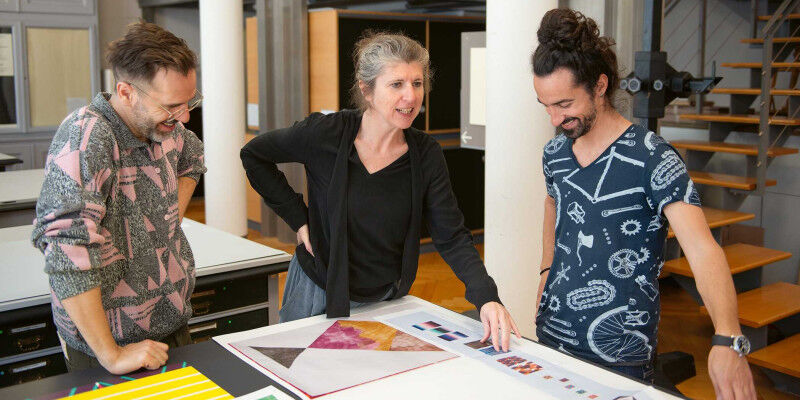
We are soon joined by Alexandra Barcal, exhibition curator and conservator for 20th and 21st century art. "Shall we run through the vitrine plan?" she asks, unfolding a printout with the order in which each work is to be hung. Collaboration is vital in this job - with fellow employees and, in this case, the artists themselves. Indeed, as Barcal explains, the upcoming exhibition marks a kind of experiment. NEOGEO is devoted to a Swiss art movement known as New Geometry, and the exhibition is quite different to most of the other shows put on by the Graphische Sammlung.Barcal, an art historian by training, wanted to offer a younger, female perspective on this art movement, focusing on the work of three contemporary female artists. A lot of work has gone into this exhibition, she explains, with a whole team of people involved in fleshing out the original idea, consulting with the artists, pulling together the final concept and then putting on the show.
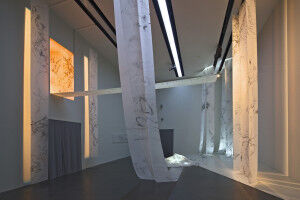
And then there’s the fact that the artists have created new works specially for this event. These will go on display in an exhibition room tucked away behind a tall double door, right next to the wall vitrines. Light and airy, the space has a parquet floor, coffered ceiling and slender, cast-iron pillars. Its period feel provides a warm backdrop to the contemporary works, most of which are now in situ.
Among the art, something else stands out in the bright and spacious room: a shiny green cabinet on wheels named MONSTER. "That’s our mobile toolbox," laughs Baumgartner. "It’s called that because it weighs almost 200 kilos!" Baumgartner’s keen eye spots some fingerprints on one of the large, framed pictures. Seizing a cloth, he carefully removes the marks. "Museum glass is tricky to clean," he explains. "It has a special coating that filters out UV and therefore protects the works against harmful light. It also has low reflectivity so as to reduce glare when people are looking at the pictures."
New exhibition concept
The works on show are from three Swiss artists, Claudia Comte, Athene Galiciadis and Andrea Heller. They are not displayed on exhibition panels, as might be expected. Instead, they serve to transform the room itself into a walk-in installation. Floor-to-ceiling woodcuts by Comte accentuate the vertical plane, while works on paper from Galiciadis - also hanging free and unframed in the room - emphasise the horizontal. Heller’s large framed drawings anchor the installation to the floor, creating a connection to the space itself. "We’ve completely changed this room for NEOGEO," says Barcal. "I had no idea what would go on display here when we started. It’s been a long creative process."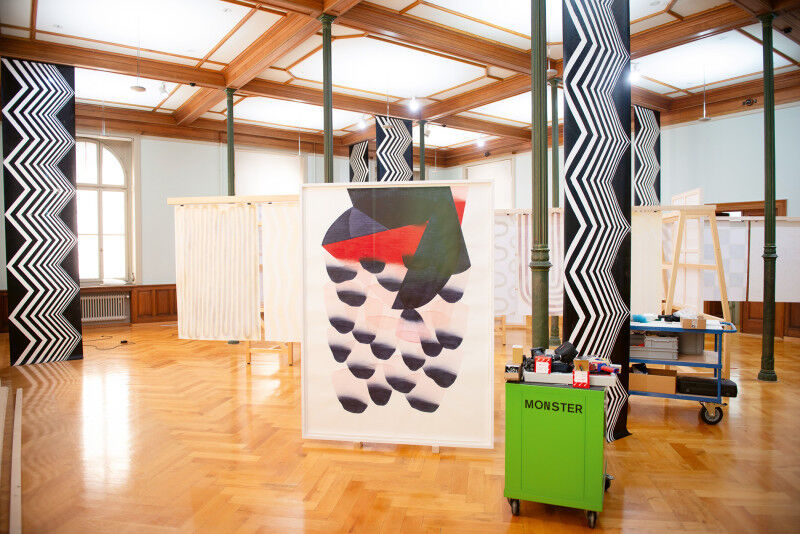
Fragile works on paper
It’s quite a juggling act, organising the exhibition while doing her day-to-day work for the collection, says Barcal. Besides her role as curator, she serves as deputy to Linda Schädler, head of the Graphische Sammlung. The ongoing work of inventorying and cataloguing such an extensive collection takes up a lot of time, not to mention the work involved in conservation, restoration and ensuring proper storage of the works. Right now, for example, Cilurzo is busy making improvements to the physical storage of the collection, aided by his immediate colleague and fellow paper conservator Olivia Raymann.Since its inception in 1867, the Graphische Sammlung has been housed in the historic main building of ETH Zurich. This brings challenges of its own: while part of the main building is air-conditioned, most of the rooms occupied by the collection are not. It can therefore be a struggle to maintain constant temperature and humidity levels. On the other hand, the building’s thick walls help keep things cool in summer.
There is also constant monitoring - including with the use of traps - to guard against a potential infestation of the collection. Potential pests include the paper fish, a relative of the silverfish. This particular insect shuns light, loves dry conditions and feeds on paper. To ensure the collection remains protected, any works donated by museums or private individuals must first spend time in quarantine.
Cilurzo uses a laser level to line up another work in the vitrine. As paper conservator, it’s part of his job to ensure that the artworks in the collection are safely stored. This means, for example, replacing any acidic mount boards, which might damage the prints and drawings, with non-acidic conservation board.
Away from his work on the exhibition, Cilurzo is busy preparing 30 works for a loan to the Helen Dahm Museum in Oetwil am See. With only half of them framed, the remaining loose sheets need to be mounted on acid-free paper to protect them against rough handling or surfaces that might damage them. This all takes place in the "Atelier". Located in the basement, this room is a well-appointed workshop, equipped with all manner of brushes, tweezers, bottles and beakers. At the sink, there are whisks and wooden spoons. "We make our own wheat-starch paste here, which we use to mount the prints," explains Cilurzo, who also freelances as a paper conservator alongside his job at the Graphische Sammlung.
With the help of his homemade glue, the prints are now attached to the mount paper via two small, folded strips of Japanese paper. This process must be reversible and may not damage the paper or leave any residue. As Barcal will later explain, it’s best to think long-term when mounting artworks: ideally, a work like this will remain attached to the same mount for centuries.
And now for the art
Two weeks later, the exhibition opens amid great anticipation. A good 240 people have come to the vernissage, with the three artists behind NEOGEO also in attendance. Guests pore over the exhibits in the vitrines and explore the installation, inspecting the works from all’angles while engaged in animated conversation.A key mission of the Graphische Sammlung is to promote the public’s understanding of and engagement with art on paper. In line with this commitment, the exhibition is open seven days a week, free of charge. Numerous events will follow the official opening, including regular guided tours, visits by school classes and private tours on selected topics.
Meanwhile, the organisation of the next exhibition is already well underway. This time, the spotlight will fall on a famous artist from the age of modernism: Pablo Picasso. "We alternate between exhibitions of historical and contemporary art," Barcal explains. "But the opportunity to try something new, together with the artists themselves, is always a great experience!"