


Social Sciences - Mar 26
"It would be naive to believe that a social media ban will solve all problems"
"It would be naive to believe that a social media ban will solve all problems"

Health - Mar 25
Cortical thickness, schizophrenia, and causality in psychiatry: when the trace is mistaken for the cause
Cortical thickness, schizophrenia, and causality in psychiatry: when the trace is mistaken for the cause







wire - news in brief
University of Basel
Results 251 - 265 of 265.
Life Sciences - Materials Science - 09.10.2015
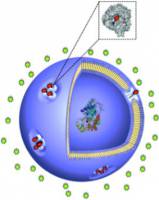
Researchers at the University of Basel have succeeded in building protein gates for artificial nano-vesicles that become transparent only under specific conditions.
Psychology - 08.10.2015
Living in Fear: Mental Disorders as Risk Factors for Chronic Pain in Teenagers
One in four young people have experienced chronic pain and a mental disorder. According to a new report in the Journal of Pain, the onset of pain is often preceded by mental disorders: an above-average rate of incidence of depression, anxiety disorders, and behavioral disorders occurs before the onset of headaches, back pain and neck pain.
Health - Pharmacology - 01.10.2015

When cells from the connective tissue collide, they repel one another - this phenomenon was discovered more than 50 years ago. It is only now, however, that researchers at the University of Basel have discovered the molecular basis for this process, as they report in the journal Developmental Cell. Their findings could have important implications for cancer research.
Life Sciences - 23.09.2015
Wolf in Sheep’s Clothing: How Scale-Eating Cichlid Fish Trick Their Prey
Displaying false information in order to deceive is one of the most ingenious survival strategies in the natural world. Zoologists at the University of Basel have now revealed a particular example of this kind of trickery in an African cichlid that is specially adapted to feeding on the scales of other fish.
Environment - 22.09.2015

Using a species of butterfly as an example, researchers from the Department of Environmental Sciences at the University of Basel have demonstrated how insects adapt their offspring to changing environmental conditions. The paper, published in the journal Ecology, shows that females pass on their own experience to their brood, even if this experience was not necessarily ideal.
Physics - 08.09.2015
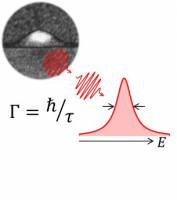
With the help of a semiconductor quantum dot, physicists at the University of Basel have developed a new type of light source that emits single photons. For the first time, the researchers have managed to create a stream of identical photons from a semiconductor. They have reported their findings in the scientific journal Nature together with colleagues from the University of Bochum.
Physics - Materials Science - 07.09.2015
Improved Stability of Electron Spins in Qubits
Double quantum dot: The three lower and upper trap up to two individual electrons, the spin states of which form the quantum-mechanical information unit. The lateral act as sensors. (Image: University of Basel, Department of Physics) Calculation with electron spins in a quantum computer assumes that the spin states last for a sufficient period of time.
Life Sciences - Pharmacology - 07.09.2015
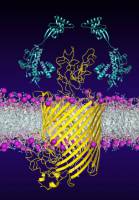
During their formation within the cells, many proteins rely on the assistance of molecular protectors, so-called chaperones. They help the proteins to fold correctly and thus ensure the right final structure. The roles of chaperones in membrane protein folding have long remained unclear. Researchers at the Biozentrum, University of Basel, and at ETH Zurich have now shown how chaperones stabilize an immature bacterial membrane protein and guide it in the right folding direction, thus protecting it from misfolding.
Health - Life Sciences - 02.09.2015
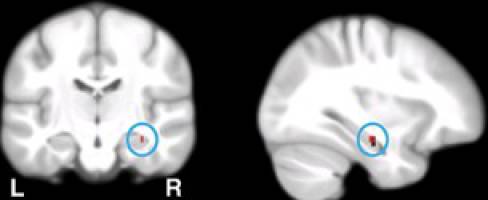
Genes are not only important for regular memory performance, but also for the development of Alzheimer's disease. Researchers at the University of Basel now identified a specific group of genes that plays a central role in both processes. This group of molecules controls the concentration of calcium ions inside the cell.
Physics - Chemistry - 27.08.2015
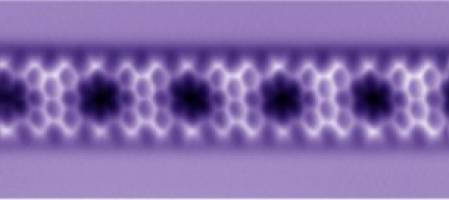
Physicists at the University of Basel succeed in synthesizing boron-doped graphene nanoribbons and characterizing their structural, electronic and chemical properties.
Life Sciences - Health - 20.08.2015
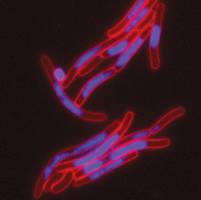
Bacteria do not cease to amaze us with their survival strategies. A research team from the University of Basel's Biozentrum has now discovered how bacteria enter a sleep mode using a so-called FIC toxin. In the current issue of "Cell Reports", the scientists describe the mechanism of action and also explain why their discovery provides new insights into the evolution of pathogens.
Social Sciences - 18.08.2015
Massacres, Torture and Mutilation: Extreme Violence in Neolithic Conflicts
Violent conflicts in Neolithic Europe were held more brutally than has been known so far. This emerges from a recent anthropological analysis of the roughly 7000-year-old mass grave of Schöneck-Kilianstädten by researcher of the Universities of Basel and Mainz. The findings, published in the journal PNAS, show that victims were murdered and deliberately mutilated.
Life Sciences - Health - 11.08.2015
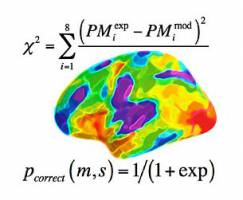
Human memory is the result of different mental processes, such as learning, remembering and forgetting. However, these distinct processes cannot be observed directly. Researchers at the University of Basel now succeeded at describing them using computational models. The scientists were thus for the first time able to identify gene sets responsible for steering specific memory processes.
Law - Environment - 29.07.2015

What are the impacts of transparency rules for treaty-based investor-State arbitration? Dimitrij Euler, a PhD student in public international law, co-edited a commentary on the new UNCITRAL Rules of Transparency.
Health - Pharmacology - 28.07.2015
Stress Hormone Reduces Heroin Cravings
Every addiction is characterized by a strong desire for a certain addictive substance, be it nicotine, alcohol or other drug. Researchers at the University of Basel recently conducted a study on heroin addiction and demonstrated that the stress hormone cortisol can reduce addictive cravings. The findings from the research have been published in the medical journal Translational Psychiatry.


Social Sciences - Mar 26
"It would be naive to believe that a social media ban will solve all problems"
"It would be naive to believe that a social media ban will solve all problems"
Health - Mar 25
Cortical thickness, schizophrenia, and causality in psychiatry: when the trace is mistaken for the cause
Cortical thickness, schizophrenia, and causality in psychiatry: when the trace is mistaken for the cause