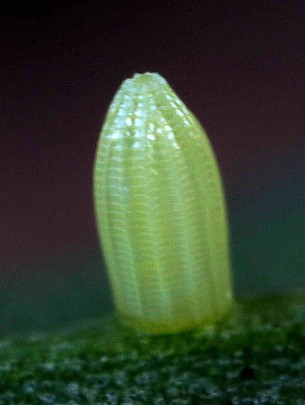
An egg laid by the small cabbage white: The young females lay their eggs specifically on plants that match their larval experience and the experience of their parents. (Image: Gebhard Müller)
Using a species of butterfly as an example, researchers from the Department of Environmental Sciences at the University of Basel have demonstrated how insects adapt their offspring to changing environmental conditions. The paper, published in the journal Ecology, shows that females pass on their own experience to their brood, even if this experience was not necessarily ideal. This rapid adaptation has huge implications for our understanding of speciation in insects. In their study, the researchers working under Prof. Andreas Erhardt firstly confirmed their earlier results, which showed that parent generations of butterflies can condition their offspring to the quality of forage plants that they experienced as larvae. Secondly, they were able to provide evidence for the first time that the mothers of these offspring change their egg-laying behavior and prefer to deposit their eggs on plants on which they themselves once developed. The Basel-based environmental scientists showed that young females of the small cabbage white (Pieris rapae) were more precise than their parents in laying their eggs on the very same plants that they (and their parents) experienced as larvae. This provided the scientists with proof of the adaptation process.
UM DIESEN ARTIKEL ZU LESEN, ERSTELLEN SIE IHR KONTO
Und verlängern Sie Ihre Lektüre, kostenlos und unverbindlich.