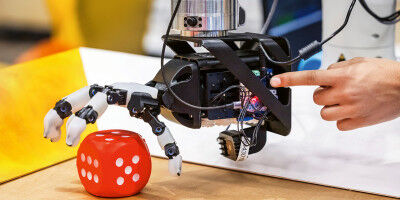
The Giotto project, launched by EPFL startup Learn to Forecast, intends to revolutionize the way we use artificial intelligence. Drawing on the science of shapes, Giotto pushes AI forward by making it more reliable and intuitive in areas such as materials science, neuroscience and biology. Giotto is open-source and available free of charge on GitHub, and it's already being used by some EPFL scientists. Researchers use artificial intelligence to solve complex problems, but it's not a transparent science: AI's computational capabilities often exceed our understanding and raise issues of reliability and trust among users. "Algorithms are becoming increasingly complex," says Matteo Caorsi, the lead scientist at Learn to Forecast (L2F). "It's very hard to understand how they work and thus to trust the solutions they provide or predict when they might get things wrong." Shapes hidden within data - To address this problem, L2F followed an intuitive approach based on the science of shapes. The result is Giotto , a free and open-source library that aims to revolutionize the way we use machine learning.
UM DIESEN ARTIKEL ZU LESEN, ERSTELLEN SIE IHR KONTO
Und verlängern Sie Ihre Lektüre, kostenlos und unverbindlich.
Ihre Vorteile
- Zugang zu allen Inhalten
- Erhalten Sie Newsmails für Neuigkeiten und Jobs
- Anzeigen veröffentlichen